
Item No. SAKSHAM CPU
SAKSHAM CPU
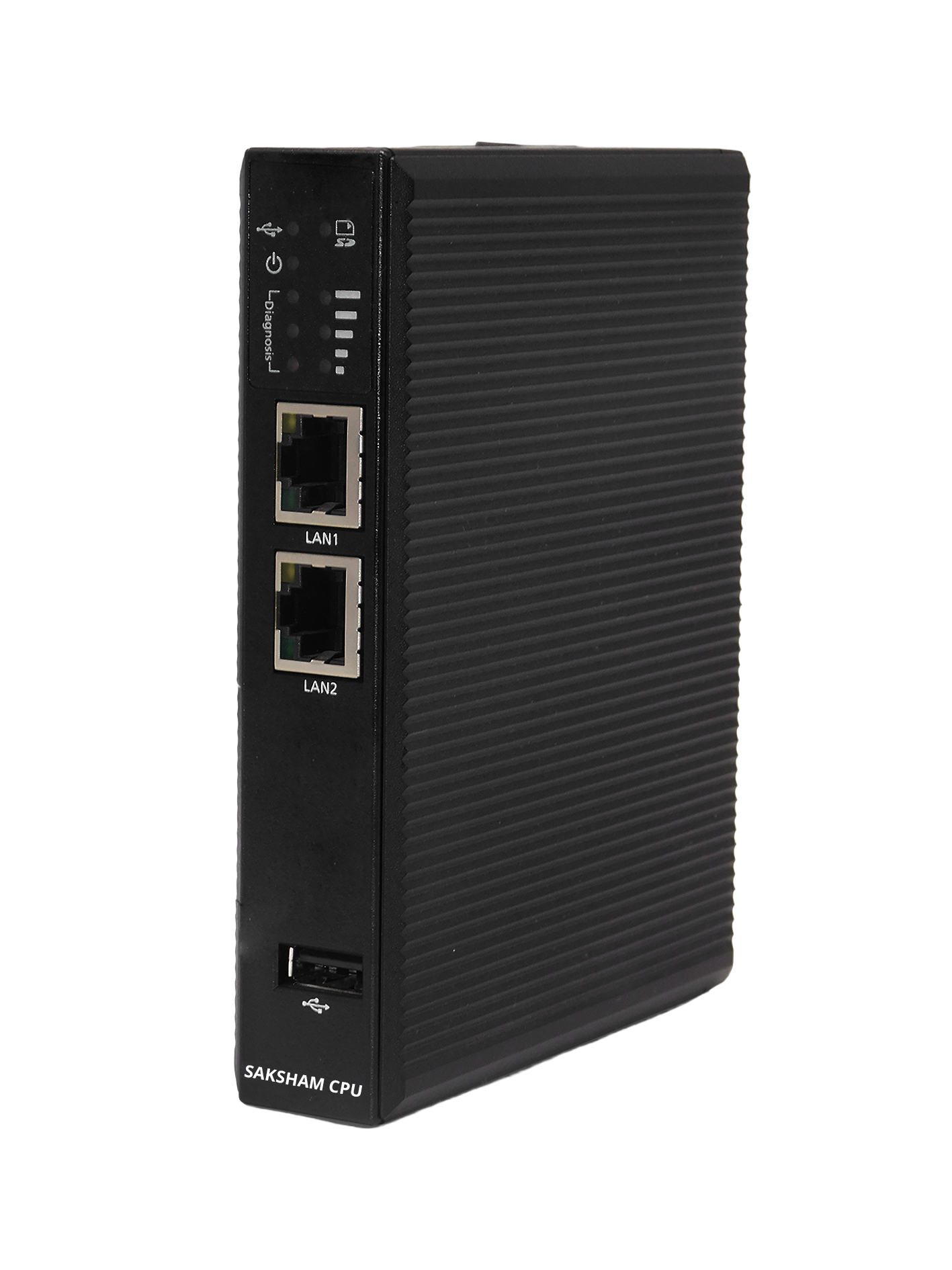
General Information
| Product | SAKSHAM CPU |
| Hardware Functional Status | From July 22 |
| Firmware Update Possible | Yes |
| Engineering Software | Codesys |
| Display | No |
| Control Element Keys | No |
| Mounting | DIN-RAIL |
Runtime Compatibility
| Language Support | IEC 61131-3 Languages: Ladder (LD), Structured Text (ST), Function Block Diagram (FBD), SFC, Instruction List (IL) — via the embedded soft-PLC runtime. |
| Other Features | Web-based HMI and online debug, variable trace, and task monitor included. |
Power Supply
| Normal Voltage | 24 V DC |
| Low Voltage | 18.5 V DC |
| High Voltage | 28.5 V DC |
| Rated Input Current | 1 A |
| Maximum Input Current | 1.5 A |
| Inrush Current Max | 2.0 A |
| Power | 10 W |
| Power Loss | 4.8 W |
Memory
| Integrated Work Memory For Program | 256 MB - 2048 MB |
| Integrated Work Memory For Data | 8 GB - 32 GB |
Hardware Configuration
Rack and Module
| No. of Module Per Rack | 8 (Any IO Mix) |
| No. of Rack | 8 Racks |
| No. of Module | 64 Maximum |
Interface Type-1
| Ethernet(RJ-45) | Yes |
| No. of ports | Up to 2 (separate MAC and IP) |
| Speed | 100 MBPS |
| Autonegotiation | Yes |
| Autocrossing | Yes |
| Industrial Ethernet Status Led | Yes |
Interface Type 2
| Serial | Up to 4 (RS 232 / RS 485) |
| Connection | Screw Connection |
Protocols
| Ethernet/IP | Available |
| EtherCAT | Available |
| Modbus TCP/IP | Available |
| Profinet IO Controller | Available |
| OPC-Ua | Available |
| Media Redundancy | Available |
Runtime Limits
| No. of Tasks | Up to 100 |
| No. of free-wheeling task | Up to 100 |
| No. of Event Task | Up to 100 |
| No. of Status Task | Up to 100 |
| Min. Cycle Time | 1 ms |
| Max. Watchdog time | 400000000 μs |
| Max. Watchdog Sensitivity | 10 μs |
Time and Date
| Clock Type | On Board RTC |
| Operating Hours Counter | Available |
| Synchronization Support | Yes |
Supported Technology Objects
| PID Control | Yes |
| Feed Forwared PID Control | Yes |
| Temperature PID Control | Yes |
| Timer | Yes |
| Counter | Yes |
| Motor and Valve Blocks and Many More | Yes |
In industrial automation, the programmable logic controller (PLC) relies on its central processing unit (CPU), the system’s brain, to ensure precise and reliable control. The CPU executes user-defined logic, interprets instructions, reads inputs, processes data, and generates outputs for actuators and other devices. It manages memory for programs, data, and settings, preventing corruption while supporting efficient operation. Modern CPUs enable seamless communication with networks, devices, and HMIs, handle protocols, and perform self-diagnostics. Their processing power, memory, and advanced features are essential for performance, reliability, and productivity.